
Legal status in the Hebrew source: an indictment was filed in March 2024 by the Central District Attorney. As of the Hebrew review on 22 October 2026, the site had not located a verdict. This translation reflects that dated account; it is not an update on the case. A person suspected or charged is presumed innocent unless convicted by a court.
In February 2022, police announced the arrest of a couple in their thirties suspected of defrauding insurers. According to the police statement reported in the media, the couple bought personal-accident policies with death cover in their own names, then allegedly reported six deaths in fatal road accidents: the husband's twice and the wife's four times. Each claim allegedly included forged medical and police documents.
What is known, and what has not been decided
N12 reported an indictment in March 2024. According to the indictment as reported, the couple faked their deaths six times and defrauded insurers. The reported amount is inconsistent: the N12 headline gives about NIS 1.5 million, while the body gives a total of NIS 1.35 million. In reports at that time, the couple's lawyer said they had not stolen the money and had been used by others. An indictment is an allegation, and defendants are presumed innocent unless convicted. As of 22 October 2026, the Hebrew site had not located a verdict or sentence. Names and the town are deliberately omitted here.
Timeline according to the reports
- Several weeks before February 2022: an insurer reports a suspicion to police. A couple bought personal-accident policies with death cover, then sought to claim using death documents. A covert investigation opens.
- Evidence gathering: investigators collect documents from several insurers. Reports allege six reported deaths: the husband's twice and the wife's four times.
- Further claims: according to police, the same method was used for cancelled overseas-trip claims, estimated at hundreds of thousands of shekels.
- 28 February 2022: police announce the arrests. After the investigation, the suspects are released to house arrest, while their assets and bank account are frozen.
- 6 March 2024: N12 reports an indictment, with a total of NIS 1.35 million in the article's body and about NIS 1.5 million in its headline. The article also includes the couple's lawyer's denial.
How the method allegedly worked
The alleged sequence is simple in principle: buy cover, submit a claim for the event that cover protects against, and attach documents supposedly showing the event happened. There is no system break-in and no impersonator on the phone. The system receives an application, checks whether the file looks complete, and decides.
The described method relies less on persuading a person than on a convincing set of well-organised documents: a medical form, police confirmation, case numbers. When documents resemble the right documents, the process moves on.
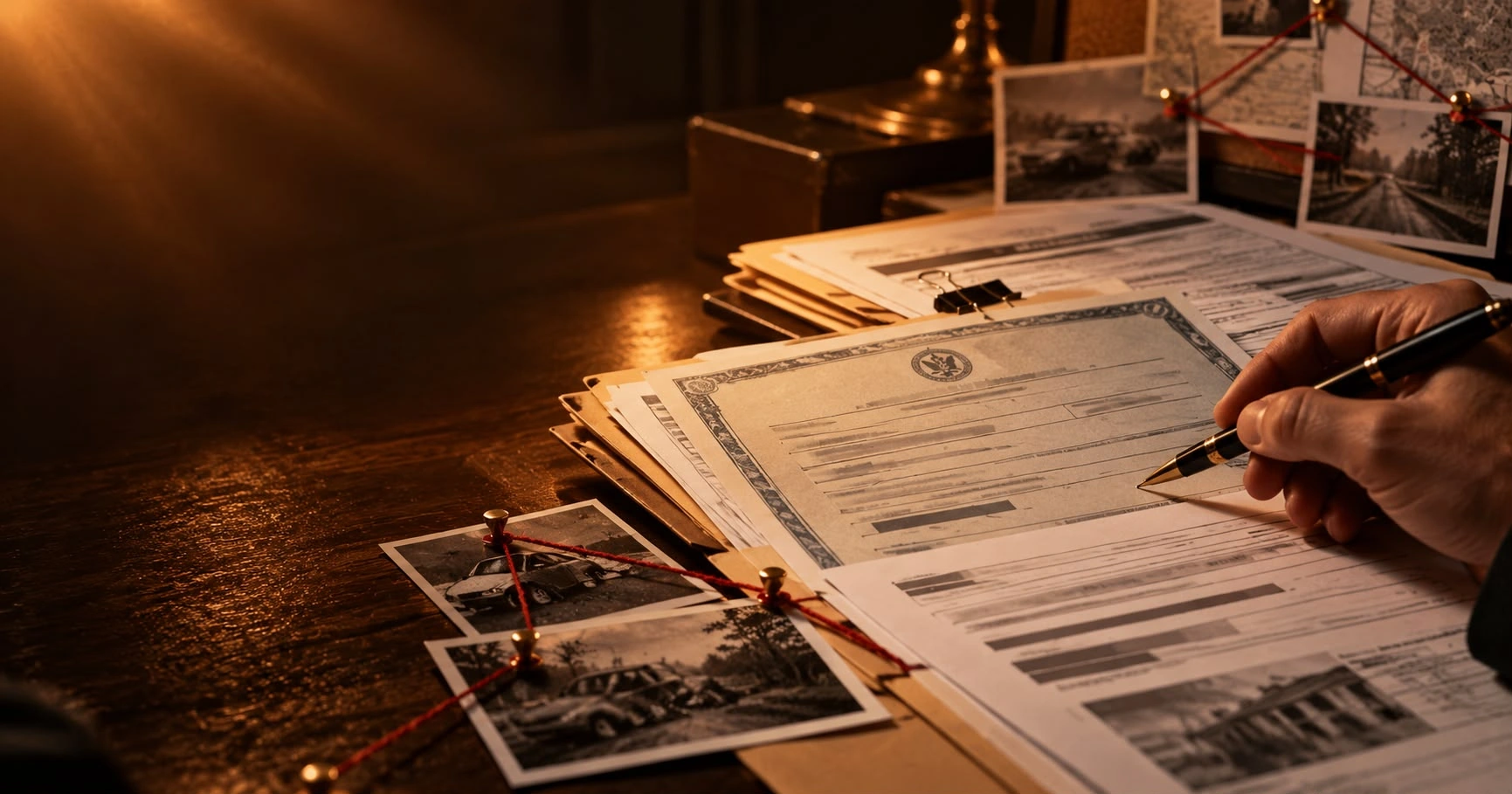
Illustration: the same pattern across three files. Each looks valid alone; only someone looking at all of them sees the line connecting them.
What repetition can teach us
Reports alleged that the same method appeared across several claims and types of cover. Examining one claim, one document against one organisation, makes this hard to see. The pattern emerges only when identity and policy history are examined across files. Reports say suspicion arose following an insurer's report, from outside the individual file.
How the case can be interpreted
This section is the site's interpretation, not a fact about the people suspected. The reports do not tell us what they thought, wanted or how they decided. Any such answer would be a guess. We can ask what kind of behaviour this method requires, and what that says about a general pattern.
This is a possible interpretation, not a diagnosis of a person. Without evidence of thought or intent, these remain hypotheses.
First, patience and repetition. A method repeated six times requires planning: buy cover, submit, receive an answer and start again. Sometimes an initial success encourages repeating what worked, creating a feeling that the system is insensitive and reducing fear. We do not know what happened here, so this is only a general pattern.
Second, distance from the harmed party. When the victim is a company rather than an individual, it can be easier to tell yourself there is no victim. This is a justification one can imagine in fraud against an organisation: "They are insured anyway." We do not attribute it to anyone in this case. It only helps explain why organisational fraud sometimes looks clean to the person committing it.
Third, partnership. When two people act together, each can reinforce the other's sense that it is normal, while sharing the risk. Again, this is a general pattern, not a finding about the couple suspected.
From an investigator's perspective
For an examiner, the question is not "Is the document forged?" but "Does the story fit everything held in the systems?" A convincing forgery may pass visual inspection. Cross-checking identity, dates and policy history makes forgery much harder and can expose inconsistencies a visual check missed.
Illustration: the document is not enough. It must be verified with the issuing body.
Warning signs for insurers
- Several death claims involving the same or related identities within a short period or across several insurers.
- Personal-accident policies bought and claimed against soon afterwards.
- Parallel claims under several types of cover, such as death and cancelled travel.
- Medical and police documents supplied by the insured person or their representative, rather than directly by the issuing body.
- An event outside Israel, where verifying documents may be harder.
What the public can take away
- An official-looking document is not proof. Verify it independently with the body that issued it.
- If you are asked to approve a document or transfer money based on one you received, independent verification is worth a few minutes.
- When the paperwork looks unusually well prepared, ask who put it together.
Related patterns: The Professional; The Insider. An apparently correct document is still only a document. One independent check costs less than any mistake.
The question I would ask as an investigator
If the pattern described in the reports did recur, what can we learn from its repetition, and what evidence would distinguish a planned method from coincidence?